High-Mix Low-Volume (HMLV) Quality Assurance for PCB Assemblies
Optimizing HMLV Inspection Efficiency with VisionXpert XC-130 By the VisionXpert Team
1. Executive Summary
This application note details the implementation of a high-resolution smart camera system designed for High-Mix, Low-Volume (HMLV) PCB inspection. The solution addresses the challenge of balancing a wide Field of View (FOV)—necessary for full-panel coverage—with the granular resolution required to detect minute structural defects across seven distinct PCB variants. By utilising an integrated edge-processing architecture, the system successfully identifies LED structural integrity (cracks/dents) and connector presence.
2. Hardware Specifications
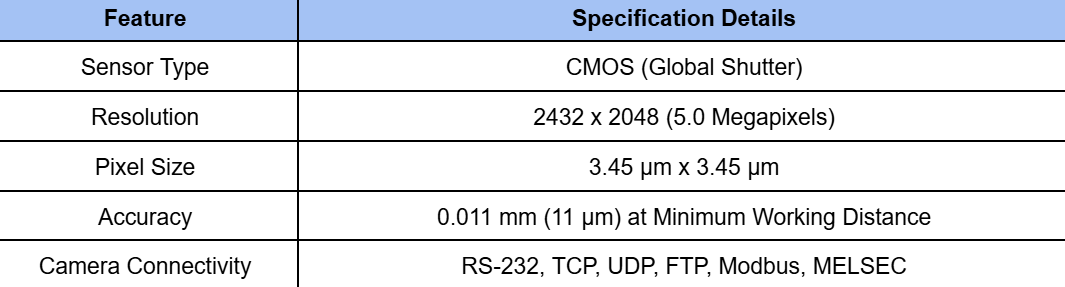
The inspection utilises the VisionXpert XC-130 Smart Camera, a standalone unit capable of edge-based image processing.
3. System Architecture and Connectivity
The XC-130 is designed for seamless integration into industrial environments, supporting multiple communication protocols for data logging and PLC handshaking:
- Edge Processing: All image analysis and algorithm execution occur locally on the camera's internal processor.
- Power Efficiency: The system operates on 24VDC with a low 6W power draw, suitable for integration into existing SMT lines.
- Protocol Flexibility: Results and images are pushed via FTP or TCP/UDP, allowing for real-time data logging.
4. Implementation Workflow
To overcome the limitations of large-area inspection, the workflow utilises the same camera model deployed at two distinct working distances to achieve specific quality goals:
4.1 Macro-Level Deployment (Full Panel Inspection)
- Setup: Positioned at a working distance of 310mm – 380mm.
- Capability: Optimises the FOV for full-panel captures (up to 398mm x 335mm), ideal for high-speed presence/absence and connector counts.
4.2 Micro-Level Deployment (Precision Defect Detection)
- Setup: Positioned at a working distance of 55mm – 135mm.
- Result: Concentrates the full 5MP camera onto a tighter area (as small as 57mm x 48mm), significantly increasing the pixels-per-millimetre. This enables the Contour Count tool to resolve cracked LED caps and dents that are physically too small.
5. Integrated Smart Lighting
A standout capability of the XC-130 is the ability to modulate its internal lighting and to reveal defects hidden by glare or low contrast.
- Polarised Contrast Enhancement: By utilising the Integrated White Polarised light source, the system effectively mitigates glare from reflective solder and metallic surfaces. This is critical for the Contour Count tool to distinguish between a healthy LED cap and one with structural cracks.
- Diffuse Illumination: For boards requiring softer, more even lighting to avoid harsh shadows on complex components, the system can switch to a Diffuse lighting mode.
- Advanced Sensitivity Tuning: To maintain high accuracy on low-reflectivity substrates (such as black solder masks), the system allows for independent adjustment of Gain and Gamma.
- Strobe Synchronisation: The lighting is managed through a Strobe Mode across Top, Middle, and Bottom LED segments, ensuring perfectly timed illumination for every capture to prevent image wash-out.
6. Conclusion
The XC-130 provides a versatile inspection gate for high-mix PCB assemblies. By adjusting the working distance and utilising integrated smart lighting, a single camera model can perform both high-level panel verification and micro-level integrity checks. This flexibility ensures that manufacturers can detect safety-critical structural defects and missing micro-components without increasing station complexity.